Loading...


Most ecommerce brands fixate on homepages and checkouts while completely missing product discovery, the crucial journey between landing on a site and finding an item. When search bars fail to handle natural human language and filters mimic dry warehouse cataloging instead of customer intent, shoppers simply leave without a trace. Optimizing this path acts as a massive revenue multiplier, transforming your entire inventory's accessibility and capturing the high-intent buyers that standard analytics completely miss.
Let me be direct about something. Most ecommerce teams spend months designing a beautiful homepage, a compelling product detail page, and a clean checkout flow. Then they ship it, drive traffic to it, and wonder why the conversion numbers still don't move.
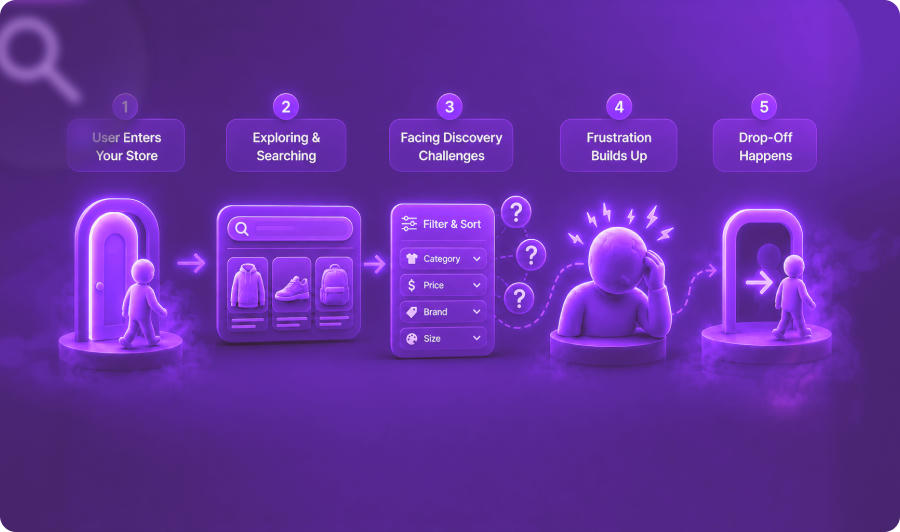
The problem is usually in the middle. The part between "customer arrives" and "customer finds what they came for." That gap has a name: product discovery. And in most stores, it's broken in ways that are completely invisible.
You see a bounce rate. You see a low add-to-cart. What you don't see is the customer who searched for "running shoes for trail" and got results for dress shoes. Or the one who filtered by size, got zero results, and assumed you didn't carry their size at all, or you show products without stock They left. The data just says they left.
That's the thing about discovery failures. They're quiet.
When a customer types something into your search bar, they're telling you exactly what they want. That's a remarkable thing. No scrolling, no browsing, no guessing. Pure intent.
Most search implementations answer that with a catalog lookup. Exact match, maybe some basic stemming, ranked by whatever the platform defaults to. And that works fine when the customer already speaks your product language. But customers don't think in SKU families or category taxonomies. They think in use cases, occasions, problems they're trying to solve.
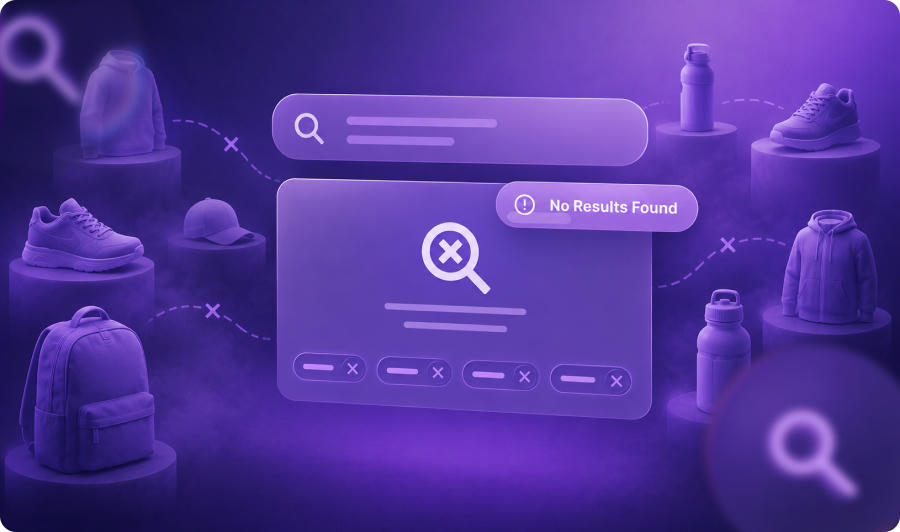
If someone types "something waterproof for hiking in the rain," that's a real query. Not a weird edge case. That's how people think. If your search returns nothing, or returns products that clearly don't match, you've broken the conversation at the most valuable moment in the entire journey.
The fix isn't only just better search technology, that matters. It's treating search as something that needs to be maintained, tuned, and monitored continuously. Which zero-results queries are happening most? Which searches result in a click but no add-to-cart? Those are the signals that show you where the language gap is.
Here's where I think most teams get it wrong. Filters are treated as a navigation tool. A way to narrow down a list. But that's a very inside-out way of thinking about it.
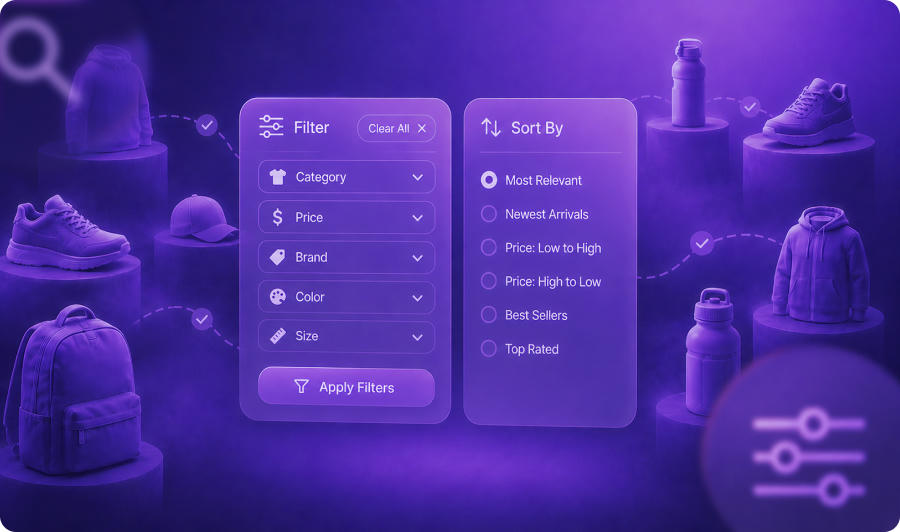
From a customer's perspective, filters are how they describe what they need. And if the options you give them don't map to how they think about the product, the filter is useless even if it technically works.
Take shoes as an example. A standard ecommerce filter set for shoes is: category, gender, brand, color, size, price. That's the warehouse talking. That's how the inventory is organized internally.
Now think about how someone actually decides on a shoe. They're thinking about what they're going to use them for, how much performance they need, what kind of terrain or surface, how it needs to feel, and then yes, size and color. The language is completely different.
So instead of "Category: Running," what if the entry point was "What are you training for?" Instead of a generic color picker, what if it was "How do you want to show up?" That's not a design exercise in creativity. That's product discovery designed for the actual human making the decision.
The best filtering systems do two things. First, they prioritize the dimensions that matter most for that specific category. Not a generic template applied to every section of the store. A shoe filter and a supplement filter and a furniture filter should all feel different, because the decision process is different. Second, they use customer language, not catalog language. That requires knowing how your customers actually talk about your products, which means listening to them, not just organizing your inventory.
Search, filters, and navigation are not features. They are the primary interface between a customer's intent and your catalog.
One thing that gets overlooked is that customers arrive at product discovery from different places with different levels of intent.
Some customers know exactly what they want. They search, they find, they buy. For them, the priority is accuracy and speed. Don't get in the way.
Some customers have a problem to solve but no specific product in mind. They browse categories, they explore. For them, the priority is a navigation structure that helps them orient. One that's built around their world, not your warehouse.
Some customers are in discovery mode. They're not sure what they want yet. They need curation, editorial, contextual suggestions, inspiration. "Best for marathon training." "Most popular for trail running." "What our team is wearing right now." These customers need a different kind of experience entirely.
When you design one discovery experience and apply it to all three, you're optimizing for none of them.
The most effective commerce experiences account for this explicitly. The homepage and category entry points serve the explorers. Search serves the intent-driven buyer. Curated collections and recommendation logic serve the ones still deciding. Each path is designed independently, with its own logic and its own success metric.
The next layer on top of all of this is personalization. Not in the overpromised, creepy-targeted-ads way. In the practical sense of: if I know something about this customer, I should use it to make their discovery experience better.
If someone has bought trail running shoes before, their filter defaults should reflect that. If someone is browsing the shoe section for the third time this week, maybe the entry point shifts from broad categories to a "pick up where you left off" view. If someone has consistently purchased in size 10, I shouldn't make them set that filter every time.
This is what I mean by predictive and personalized input. It's not about building a complex AI recommendation engine from scratch. It's about using the signals you already have to reduce the work the customer has to do. Every click they don't have to make is one less reason to leave.
None of this happens by assumption. The reason most discovery experiences feel like they were built for the catalog and not the customer is because they were. Nobody stopped to ask.
The foundation of a good discovery path is understanding. Not just analytics, not just heatmaps, but the full picture of how users actually move through the experience. Where do they enter. Where do they slow down. Where do they try something, fail, and try again. Where do they give up entirely.
That data tells you where friction lives. But it doesn't tell you why. For that you need to go closer. Session recordings, search query analysis, support ticket themes. What are customers asking for that the site isn't giving them. What language are they using that doesn't match what the filters offer. What paths are they attempting that the information architecture doesn't support.
When you combine both layers, the behavioral data and the intent behind it, you get something actionable. You understand not just what users are doing but what they were hoping to do. And from there you can design discovery paths that actually map to real goals, real contexts, real friction points.
That's the work. It's not glamorous but it's the difference between a filter set that looks complete and one that actually helps someone find a shoe for their first trail race.
Hearing users, analyzing behavior, and understanding their goals and friction points. That's how you build discovery paths that actually convert.
If navigating your store or finding specific products felt harder than it should during your own test, you are likely leaving revenue on the table. We can help you turn those invisible drops into clear conversion wins.
Contact us today to learn more about our UX services or schedule a comprehensive review of your digital conversion path.
.webp?compression=lossy)

.webp?compression=lossy)