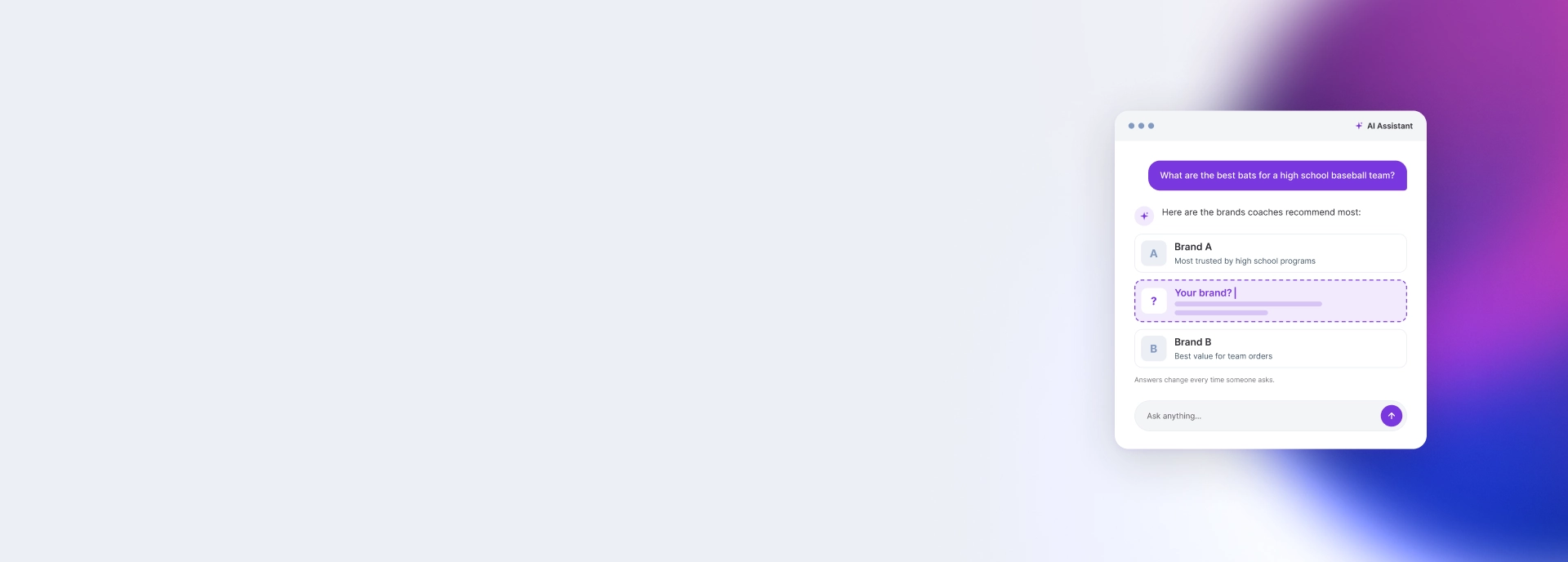
A high school baseball coach needs a dozen new bats before the spring season. A few years ago they would have searched Google, opened six tabs, and compared reviews between practices. This year they ask ChatGPT. It gives them three brands, a couple of sentences on each, and a link. They click the second one and request a team quote.
If you sell baseball bats, you'd want to know whether you were one of those three names. Most companies have no idea. There's no ranking report for that conversation and no alert telling you a sale went elsewhere. It just happens, quietly, thousands of times a day.
That blind spot is what AI visibility is about. And it's why we think prompt tracking deserves a spot next to the keyword reports you already get.
What AI visibility actually means
AI visibility is how often your brand shows up, and how it's described, when people ask tools like ChatGPT, Gemini, Perplexity or Google's AI Mode a question your business should be able to answer.
It sounds like organic search visibility, and the two are related. The difference is who does the choosing. Google hands a searcher ten links and lets them decide. An AI assistant reads around, forms an opinion, and hands back a short list. If you're on page one of Google, a shopper can still scroll down and find you. If you're left out of the AI's answer, there's nothing to scroll.
Why this deserves attention now
For a while it was reasonable to treat AI traffic as a curiosity. The volume was small and the visitors didn't buy much. As recently as July 2025, Adobe's data showed a visit to a U.S. retail site from a regular channel was worth 128% more than a visit from an AI tool.
That flipped fast. By July 2026, AI-referred shoppers were converting 60% better than everyone else and bringing in 53% more revenue per visit. AI-driven traffic to those same retail sites was up 62% from a year earlier (Adobe Digital Insights).
So in roughly a year, the AI shopper went from your least valuable visitor to one of your most valuable. That makes sense when you think about it. They arrive having already done their research, because the assistant did it for them.
Here's the part that bothers me. Those figures only count people who clicked through. They say nothing about the shoppers who asked the same question and got handed a competitor's name.
Why checking ChatGPT once tells you almost nothing
The natural move is to open ChatGPT, type a question about your category, and see if you come up. We've all done it. I've done it more times than I'd like to admit.
The trouble is that AI answers move around. A lot. Earlier this year, Rand Fishkin of SparkToro and Patrick O'Donnell of Gumshoe.ai had 600 volunteers run 12 prompts through ChatGPT, Claude and Google's AI nearly 3,000 times. The odds of getting the same list of brands twice were under 1 in 100. The odds of getting that list in the same order were closer to 1 in 1,000 (SparkToro).
So if you checked on Tuesday and you were third, that was one roll of the dice. Wednesday you might be first. Or gone.
One thing in the study did hold steady: how often a brand appeared across many runs. Ask a question 100 times and the strong brands keep turning up, even as the order shuffles. Fishkin went in a skeptic and came out convinced that this appearance rate is a reasonable metric, while ranking position isn't. That percentage is the number worth watching, and it's what prompt tracking is built to measure.
What prompt tracking looks like in practice
Prompt tracking is keyword tracking for the AI era. You pick the questions your buyers are likely to ask, run them through the major AI tools on a schedule, and record what comes back. Over a few weeks you get a picture you can actually trust.
The hardest part is choosing the questions, and that starts with a conversation rather than a tool. Go back to our baseball coach. They probably aren't typing "baseball bat." They're asking which high school-approved bats get the best reviews from players, what other programs in their conference are swinging, or whether last year's models are worth the discount. Those are the prompts that matter, and every business has its own version of them.
Once the questions are set, four things tell you most of what you need to know:
- How often you appear. Out of every 100 times a prompt runs, how many answers mention you? This is your baseline, and it's the number you'll report on.
- Who appears instead. The brands named when you aren't. This list surprises people, and sometimes it includes a company nobody on your team considered a competitor.
- What the AI says about you. Being mentioned as "a budget option with mixed reviews" is a very different outcome from being called the one most programs trust.
- Where the AI gets its information. These tools pull from review sites, forums, trade publications and your own pages. The sources they cite show you where your reputation is really being formed.
None of this is a one-time audit. Models get updated, competitors publish new content, and the answers drift. Checking monthly is how you tell whether your work is moving anything.
The technical foundation AI depends on
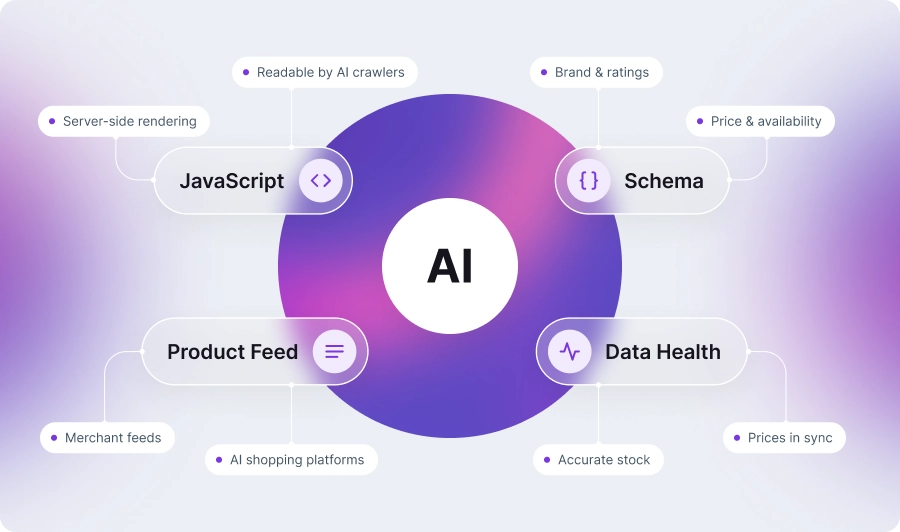
This is where I put my SEO hat on. Before an AI can recommend you, it has to read your site, understand your products, and trust that the details are accurate. A lot of sites stumble at the first step.
Most AI crawlers can't run JavaScript
Many modern ecommerce sites build their pages inside the visitor's browser using JavaScript. You see a finished product page. A bot that can't run JavaScript sees a mostly empty shell.
Google handles this fine. Its crawler renders JavaScript, and Gemini benefits from the same setup. The crawlers behind ChatGPT, Claude and Perplexity are a different story. A crawl-log study from Vercel and MERJ found that none of the major AI crawlers it measured executed JavaScript. OpenAI's GPTBot and Anthropic's ClaudeBot download JavaScript files but never run them (Vercel).
So if your prices, specs or reviews only appear after a script runs, those crawlers miss them entirely. It's the same reason Romina, our Senior Web Analyst, argues for menus that work without JavaScript in Why Google is a Librarian, Not an Art Critic. The usual fix is server-side rendering, which means your server sends the finished page instead of asking the browser to assemble it.
Schema labels your products for machines
Schema markup is a small block of code that labels the facts on a page. This is the price. This is the brand. This is the rating, and yes, it's in stock. Shoppers never see it. Machines read it first.
Think back to our coach. If a bat's length, weight and certification only appear in a paragraph of marketing copy, an AI has to guess which number means what. Schema removes the guessing. Just make sure it lives in the page's original HTML, for the JavaScript reason above.
Product feeds are becoming the front door
This is the shift I'd watch most closely. AI shopping tools increasingly rely on product feeds, the structured files merchants send straight to a platform. Google's AI Mode and Gemini draw on the Merchant Center feed many brands already maintain, and OpenAI now accepts merchant feeds for ChatGPT Shopping.
The change has been fast. Profound tracked more than 1.7 million ChatGPT Shopping prompt runs and found that on July 10, 2026, the share of product picks pulled from merchant feeds jumped from about 8% to about 62% in a single day. By Profound's estimate, brands without an integrated feed are now out of the running for roughly 65% of ChatGPT's product recommendations (Profound).
Without a feed, ChatGPT pieces your catalog together from whatever it finds on the open web. I wouldn't want to leave that to chance.
Data health holds it all together
Your site, your schema and your feed all describe the same products. When they disagree, you have a problem. A feed that says $249 next to a product page that says $279 confuses every system reading it, and Google Merchant Center will disapprove products over mismatches like that.
Data health is the unglamorous work of keeping those sources in sync: complete attributes, accurate prices, current stock, no ghost products that were discontinued last season. It's tedious. It's also the difference between an AI describing your bat correctly and recommending someone else's because yours looked unreliable.
What actually moves the number
Most of what earns AI visibility is work a well-run ecommerce site should be doing anyway. Prompt tracking just shows you whether it's paying off.
With the technical foundation in place, two things carry the most weight.
First, your pages need to answer questions plainly. Who is this product for? What's it made of? How does it compare to the alternative? Pages that say these things directly are much easier for an AI to pick up and repeat. Our post on semantic clarity goes deeper on writing for meaning instead of keywords.
Second, other people need to be talking about you. Reviews, Reddit threads, industry roundups and press coverage all feed what an AI "knows" about a brand. A company that only describes itself on its own website is easy to overlook.
Without tracking, you make these improvements and hope. With it, you can see your appearance rate shift on the prompts that bring in revenue, and you can tie that shift to the changes that caused it.
Do you know what AI is telling your customers?
Your buyers are already asking these tools for advice. Some of them are asking about your category right now. It's worth finding out what they hear.
At Mira Commerce, we help brands see where they stand in AI search and close the gaps, from technical SEO and structured product data to content built around the questions real customers ask. Contact us to talk about improving and tracking your brand's AI visibility.