


n8n in Practice: System Orchestration
Read at a Glance
If you are deciding where to position n8n in your tech stack, use it to orchestrate APIs, connect platforms, and integrate automation without writing boilerplate integration code. Just keep in mind that it should not replace your primary compute layer or be used as a heavy ETL engine for massive data pipelines.
Introduction to n8n
n8n is a powerful workflow automation platform. What makes it particularly interesting is its ability to let users build and deploy automation workflows through a graphical interface with minimal manual coding, effectively combining low-code development with the flexibility of traditional programming.
However, even though it is a low-code platform, n8n is primarily developer-oriented. Building robust, production-grade workflows still requires a solid technical background, including a deep understanding of JSON payloads, HTTP response codes, conditional logic, loops, and error handling.
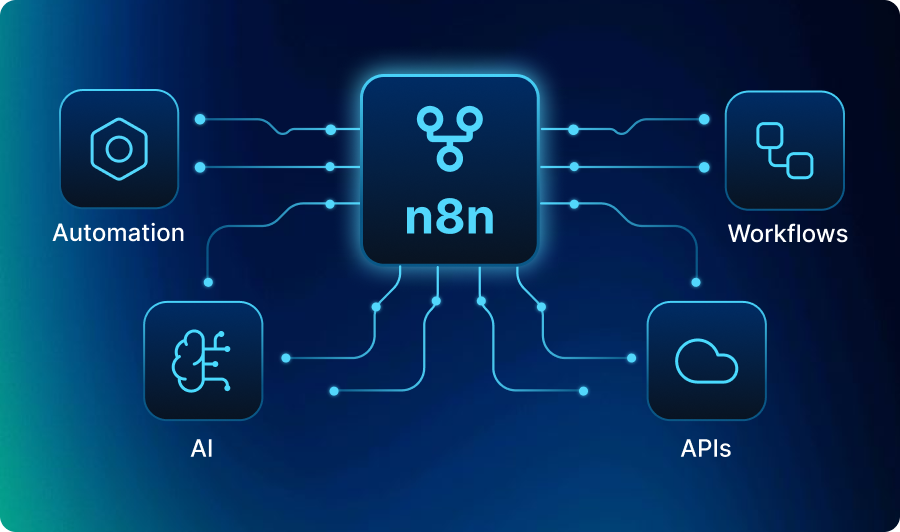
Workflows are built by placing nodes onto a canvas and connecting them. These nodes represent triggers, actions, data transformations, or integrations with external platforms, with the connections between them representing data flows.
In practice, n8n is much more than just a simple automation tool; it acts as an orchestration layer between systems. APIs, messaging platforms, collaboration tools, AI providers, and ERPs can all be seamlessly coordinated through a single workflow to achieve a desired outcome.
The platform provides hundreds of pre-built connectors to integrate workflows with external services. When a dedicated node is not available, you can always rely on the generic HTTP Request node, which fully supports custom authentication, headers, payloads, query parameters, throttling, and pagination. This means that virtually any system exposing an API can be integrated graphically into your workflow.
Why Automation Matters
Automation is generally associated with saving time on repetitive tasks and reducing human error by eliminating manual work. By accelerating operations, processes that used to take hours can be executed in minutes. Furthermore, because workflows can be scheduled to run 24/7 without interruption, businesses see significant cost reductions. While automation does not completely eliminate errors, it standardizes processes and ensures the quality and accuracy of results, drastically reducing the cost of rework.
Crucially, automation is not about replacing human talent. Its main benefit is strategic. By freeing up human resources, it allows teams to focus on higher-value tasks that require creativity, critical analysis, and strategic decision-making.
Additionally, automation breaks down operational silos. It facilitates integration and collaboration by connecting isolated systems into a single flow, sending automated notifications, reducing dependence on manual handoffs, and streamlining how cross-functional teams work together.
Building Real Workflows
My experience with n8n has primarily revolved around system integration and operational automation. Due to the nature of the problems I have had to solve, I have mostly deployed deterministic workflows.
I started by building simple automations, but over time, these evolved into complex orchestration pipelines coordinating various platform APIs and core services.
As your workflows grow in complexity, you quickly realize that there is more to them than simple automation. At a certain scale, workflow design begins to resemble traditional backend engineering. If you do not approach it with that mindset, the workflows can become operationally fragile.
AI and Modern Automation
AI has fundamentally changed how we build workflows. Traditional workflows are deterministic: given the same input, they will always produce the exact same output. AI introduces probabilistic behavior into the mix. This shift creates massive opportunities, but it also introduces new risks.
n8n is well regarded for its advanced AI capabilities. The platform allows you to create AI agents, connect LLMs from various vendors, and integrate memory, RAG (Retrieval-Augmented Generation) databases, and custom tools. This enables agents to reason over prompts, analyze provided information, and take autonomous actions across external platforms. It also supports Model Context Protocol (MCP) capabilities. Advanced setups can even involve entire fleets of collaborating agents.
However, with all the current hype surrounding AI, it is vital to remember that not every workflow requires an AI agent. You must thoroughly understand the specific problem you are trying to solve to choose the right tool for the job.
If you need to summarize text, search a knowledge base, build a chatbot, perform semantic searches, generate marketing content, or classify images, LLMs excel at these tasks. On the other hand, if you need to set up a Jira project with specific schemas based on structured input, that is a purely deterministic task. Transactional consistency still requires predictable, deterministic systems.
Lessons Learned
One of the most important lessons I have learned is that automation is not just about reducing effort; it is about reducing coordination complexity.
I have also learned that n8n excels at acting as a coordination layer rather than the primary compute layer for large-scale data processing. Attempting to use n8n as a heavy ETL platform can become problematic at scale. Heavy data transformations, memory-intensive processing, or highly parallel data pipelines are generally better handled by specialized data engineering tools.
To help visualize where n8n shines and where it hits its limits, here is a breakdown of its operational strengths and weaknesses based on real-world application:
The workflows that perform best are those where n8n acts as the conductor, not the entire orchestra.
At the same time, remember that not everything should be automated. There is often a temptation to automate a process simply because it is technically possible, even if the underlying process itself is unstable or poorly defined.
Good automation always starts with clarity. The most successful workflows are those that automate processes that are already deterministic, highly repetitive, and operationally expensive to maintain manually.
Need help with your system architecture?
Are you looking to scale automation or to integrate enterprise systems? Our team is ready to support your digital transformation journey. Let us discuss how we can build a resilient foundation for your operations. Contact us today.
Related Posts




.webp?compression=lossy)

.webp?compression=lossy)