

Over the last few months, many BigCommerce merchants in our network have been getting the same call. A Shopify enterprise rep reaches out, walks through a slide deck with the merchant's own name on the title page, and makes the case that moving to Shopify will cost less and convert more. The centerpiece is usually the same statistic: Shopify's total cost of ownership is "31% better on average" than BigCommerce's, sourced to Shopify's own published article on the subject. Slides follow showing an 88% implementation-cost gap, a 21% support-cost gap, a 12% conversion edge, and a research-and-development budget Shopify says is 17 times BigCommerce's.
None of that is fabricated. All of it is real, in the narrow sense that Shopify really did commission the study and really does spend that much on R&D. But "real" and "proven for your business" are different things, and in every one of these conversations, the merchant was never shown the study itself, never told who ran it, and never asked what their own numbers would say. I went and checked what I could independently verify against Shopify's own blog post, the actual slide deck being used, both companies' Q2 2026 earnings releases, and independent platform-adoption data. I'm publishing the results here, plainly, including the parts that don't flatter BigCommerce.
This isn't an anti-Shopify piece. Shopify is a genuinely formidable platform executing well on several fronts, and I will say so throughout this article. It's a pro-clarity summary, for merchants trying to make a real decision instead of reacting to a sales deck, whichever direction that decision ultimately points.
Side note: I must also say that I am in contempt of shallow generic "Battle Cards" that each ECP, including BigCommerce, and Shopify, have on each other. These are absolutely useless documents, intended to educate their SDRs and Account Execs on how to sell against their competition, usually put together by highly motivated folks with very little field experience. Never up to date and never specifically addressing a unique merchant's needs, they're often easily surpassed by a quick meaningful AI LLM prompt. This article is intended to give a more objective perspective on both platforms to someone seeking to go beyond a sleek (for the most part) platform sales pitch.
The Pitch You're Getting
Strip the framing and here is what Shopify's enterprise sales team is telling BigCommerce merchants right now, drawn directly from their many competitive decks I reviewed and from Shopify's own published TCO article:
Total cost of ownership: "31% better on average, up to 36% better" than BigCommerce, based on a study Shopify commissioned from an unnamed "leading independent consulting firm," fielded between December 2023 and January 2024.
Implementation cost: BigCommerce is "88% higher," and launches are "36% faster" on Shopify.
Operating and support cost: BigCommerce runs "21% higher" due to "enterprise functionality limitations."
Conversion: Shopify's checkout "converts 12% better" than BigCommerce's, with Shop Pay adding a further 15.2% conversion lift and 15% average-order-value lift on top of that.
R&D investment: Shopify invested "$1.4 billion" in R&D in 2025 "far surpassing BigCommerce's $80 million," alongside "over 600 new features in 24 months."
Migration momentum: roughly six brands move from BigCommerce to Shopify for every one that moves the other way, per StoreLeads data Shopify cites in its own decks.
Each of these is a real number that traces back to somewhere. The question worth asking is the one the sales decks don't invite: What each number is actually measuring, how current it is, and what it leaves out?!?
What Holds Up, What Doesn't
The 31% TCO number is two and a half years old and the firm behind it has never been named.
Shopify's own published methodology says the study was fielded between December 2023 and January 2024, surveying enterprise executives in North America, and conducted by a consulting firm Shopify declines to name in the article itself. By the time this number appears in a mid-2026 sales conversation, it is describing pricing, feature sets, and AI capability on both platforms as they existed roughly two and a half years earlier; before Shopify's Agentic Storefronts, before BigCommerce's Feedonomics agentic tooling, before either company's current pricing and advances on payments in their respective checkouts. That doesn't make the number false. It makes it unverifiable and stale, which for a number this consequential is close to the same problem. Ask for the firm's name and the underlying methodology before you let it anchor a decision; if it isn't shared, model your own TCO against your actual payment mix, app stack, checkout customizations, and integration footprint instead of an industry average from early 2024.
The R&D comparison is real and it's measuring company size, not commitment.
I pulled the R&D line directly from both companies' own Q2 2026 financial filings last week rather than taking either side's framing. CMRC reported $17.7 million in R&D expense against $84.5 million in quarterly revenue, about 21% of revenue. SHOP's own disclosed non-GAAP R&D ratio for the same quarter was 10% of revenue. In other words: Shopify's R&D budget is around 20 times larger in absolute dollars, because Shopify's revenue is roughly 40 times larger. Measured as a share of every revenue dollar coming in, BigCommerce is reinvesting close to double what Shopify is. Both framings are true. "$1.4B vs $80M" tells you about scale; it tells you nothing about whether either roadmap is better matched to your business.
One can argue about the pace of innovation and the volume of new features the absolute size of R&D dollars enable, so it's definitely worth comparing the roadmap execution of both companies; but I would argue that with shopping carts largely becoming commodities in the brave new composable and agentic digital commerce space, we must zero in on their AI advances, which I cover below.
The migration ratio is real, and BigCommerce shouldn't pretend otherwise; but it's the wrong number to be arguing over.
This one is actually interesting. Independent data from StoreLeads (which both companies cite, take a look - CMRC and SHOP) does show meaningfully more stores moving from BigCommerce to Shopify than the reverse. Shopify's own deck cites roughly 6-to-1 over a multi-year window, and our own pull of StoreLeads' most recent 90-day snapshot shows a similar pattern (322 BigCommerce merchants departing to Shopify against 96 moving the other way). BigCommerce's total live store count is down 11% year-over-year; Shopify's is up 11%. I'm not going to spin that away. it's a real headwind and a fair data point for Shopify to raise.
What it leaves out is the shape of BigCommerce's business underneath that number.
In the same period, BigCommerce/Commerce grew gross merchandise volume 14% year-over-year, posted its first back-to-back GAAP-profitable quarters in company history, and improved net revenue retention for a third consecutive quarter, all while total store count fell. That combination (fewer stores, more volume, better margins) is the signature of a company trading a long tail of smaller, lower-complexity accounts for fewer, larger, stickier upper mid-market, Enterprise, and B2B relationships, which is a different business than "losing to Shopify" implies, even though both things are happening at once. A raw migration ratio counts a five-figure small gadget shop switch the same as a $50 to $250+ million brand renewal; it's a real number, but it's the wrong number to decide your own move on.
But there's a more interesting number buried in the same two StoreLeads reports, and it's the one nobody's slide deck shows: where merchants go when they leave, broken out by destination. Look past the BigCommerce-versus-Shopify scoreboard and a third category shows up in both reports: StoreLeads tracks it simply as "Custom Cart," its catch-all for merchants who leave a packaged platform to build on their own, typically headless, stack.
On BigCommerce's side, the story really is mostly Shopify.
Of the 505 merchants who left BigCommerce in StoreLeads' most recent 90-day window, 322 (64%) went to Shopify, versus 69 (14%) to Custom Cart and 65 (13%) to WooCommerce. Yes, for BigCommerce specifically, losing merchants to Shopify is the dominant pattern in this data, not merchants graduating to a custom build. A meaningful share of that outflow, per merchants and tech partners we talk to, is smaller stores (like, VERY small, paying $50/month store subscription fees) leaving BigCommerce's older, Blueprint template-based storefronts for Shopify's more turnkey setup. That is a real and fair criticism of the lower end of BigCommerce's own installed base, and one more reason the newer, Catalyst-first and Makeswift CMS push described below matters.
By the way, we did take a very close look at the segment of BigCommerce clients using Blueprint templates still after all these years; and there is just no meaningful way for anyone to offer them an alternative except for Shopify; it is ultra-convenient to self-serve and operate by these tiny entrepreneurial businesses, like a friend of mine who restores and builds electric guitars as a side gig and who setup his own shop in less than an hour.
On Shopify's side, the story is genuinely different.
Of the 11,190 merchants who left Shopify in the same kind of window, WooCommerce took 3,522 (31%), but Custom Cart took 3,195 (29% !!!), a near-tie for the top destination. BigCommerce isn't even large enough to appear as a named top destination in Shopify's own outflow data, even though I do know of merchants who recently moved to BigCommerce from Shopify, some quite large multi-brand PE-financed brands. Put plainly: when merchants outgrow Shopify, they are close to three times as likely to walk away and build something custom as they are to move to WooCommerce, and BigCommerce barely registers as the place they land instead.
Read those two reports together and the honest conclusion isn't "BigCommerce is winning" or "Shopify is winning". It's that composable/custom is a bigger competitive threat to Shopify specifically than BigCommerce is, at least among merchants sophisticated enough to leave a fully-managed SaaS platform behind. That reframes the whole "6-to-1" conversation: the more consequential migration isn't merchant-to-merchant between two platforms, it's platform-to-custom. Both companies clearly know this, which is exactly why each has spent the last two years building an official, supported on-ramp to headless rather than simply letting that cohort walk: Shopify's Hydrogen and BigCommerce's Catalyst, covered in detail below.
I would be very curious to compare the number of merchants that sell $50m+ in GMV on Shopify and on BigCommerce. And then do so for $100m+; and then, for $250m+. And then split it by industry vertical. And then - by whether its a templated site / family of sites or a fully headless custom web app plugging their shopping cart in via the APIs. Those kind of stats will really tell a true story for high volume merchant operators with the meaningful unique needs.
Shop Pay's numbers are credible and Shopify's own sales team already told the client the limits.
The Shop Pay conversion and AOV lift figures (15.2% and 15%, respectively) are consistent with numbers Shopify has published elsewhere, and a 250-million-account, one-tap checkout network is a genuine, hard-to-replicate advantage for a brand whose buyers already have Shop accounts. But in multiple Shopify public calls and case study presentations I reviewed, Shopify's own reps always concede two things worth weighing against the headline: there is "no self-serve tool for a merchant to write and send custom messages" to their own Shop app followers. Marketing to them "is run by Shopify, not the merchant" and "the majority of merchant's sales" will still come directly from the merchant's own site, with Shop functioning mainly as "a discovery + identity + re-engagement layer," not a checkout destination. Read that again: you can't message your own followers and the app becomes the layer in the middle. This is the most legitimate architectural trade-off in the whole pitch: real conversion lift, in exchange for a customer relationship you don't fully control.
BigCommerce's July 2026 checkout speed improvements significantly narrow the conversion gap.
In July 2026, BigCommerce announced substantial checkout performance improvements that directly address Shopify's conversion advantage claim:
41% faster checkout load times compared to January 2026.
63% improvement in Largest Contentful Paint (LCP), dropping from 2.7 seconds (December 2025) to 1.0 second (July 2026); a metric directly correlated with conversion, customer perception of speed, and Google-assigned Core Web Vitals - a proxy for site usability metrics.
Technical optimizations including JavaScript bundling, parallelized API calls, and enhanced caching strategy.
Automatic deployment to all stores using Optimized One-Page Checkout with no merchant configuration needed.
The timing is significant: these improvements were deployed strategically before peak 2026 shopping season, when checkout friction matters most to conversion. The 63% LCP improvement alone represents a direct competitive response to checkout-speed-based conversion claims, narrowing Shopify's "12% conversion advantage" argument by targeting the loading-time friction that drives abandonment. While Shopify's Shop Pay remains a network-effects advantage Shop cannot replicate, the checkout speed delta, (long a weakness in BigCommerce competitive comparisons ) is no longer Shopify's clear win.
App Ecosystems: Shopify's App Stack vs. BigCommerce's Integration Layer
One critical architectural contrast between Shopify and BigCommerce lies in how each platform utilizes its app ecosystem. While both platforms maintain active marketplaces, their operational philosophies differ sharply.
On Shopify, solving complex requirements like enterprise B2B typically demands stacking dozens of monthly subscription apps. What begins as a quick plugin solution often turns into app bloat, performance drag, and compounding recurring costs.
BigCommerce treats the app layer differently. Instead of relying on marketplace apps to deliver core functionality, its ecosystem functions primarily to host connectors for enterprise integrations like ERPs, PIMs, and OMSs. To be candid, this approach comes with a clear tradeoff: Shopify undeniably has a broader selection of native apps for daily promotions and merchandising, which remains a fair criticism of BigCommerce.
However, when managing complex, merchant-specific requirements, I find building custom serverless cloud apps on BigCommerce to be the superior route. By connecting lightweight cloud applications directly to the storefront, admin console, and back end, tailored business logic and data handling reside safely within your own infrastructure. Should you ever replace your shopping cart down the road, that custom code survives the transition intact.
Comparing the two approaches directly: building decoupled cloud applications on BigCommerce provides a far more future-proof architecture than depending on an extended stack of third-party Shopify subscription apps.
Two Very Different Companies Right Now
Strip away both sales decks and look at what each company actually reported for the second quarter of 2026:
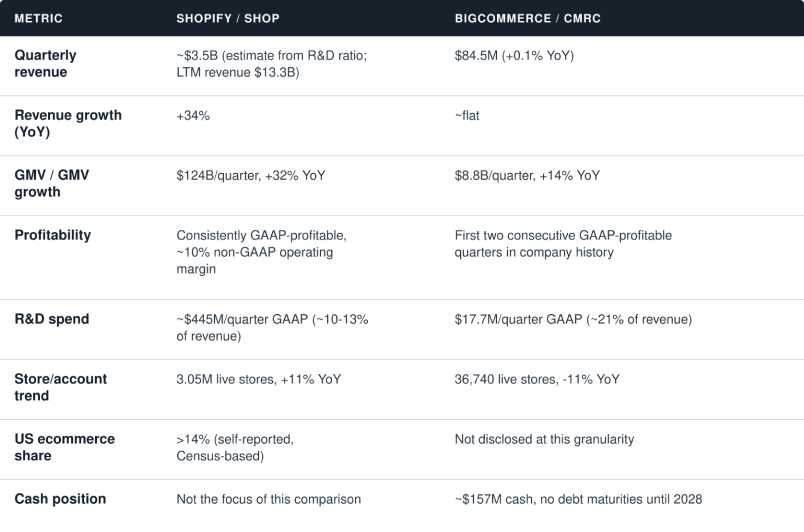
Shopify / BigCommerce financial metrics Q2 2026
The truth is - these are two different kinds of companies solving two different problems. Shopify is a large, fast-compounding consumer-commerce network still growing at software-company speed, with the balance sheet and R&D budget that scale buys. Commerce (BigCommerce's new parent, alongside Feedonomics and Makeswift) is smaller and growing much more slowly on a store-count and top-line basis, but it has just turned the corner to sustained profitability while explicitly repositioning around enterprise, B2B, and openness rather than trying to out-scale Shopify's consumer network. Both facts matter, and which one matters more to you depends entirely on what you're building.
Strengths & Gaps, Without the Sales Gloss
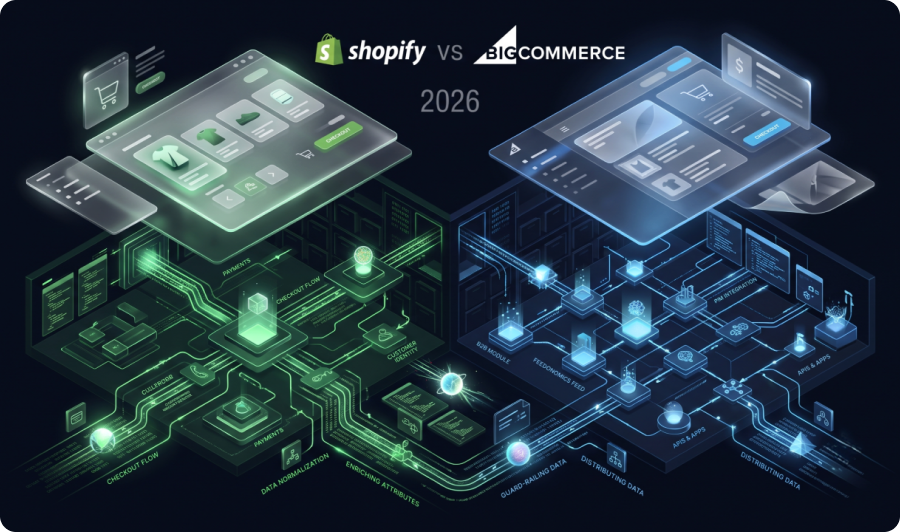
I put together this very simplified comparative view of both platforms' surfaces; while I hate it when people simply very complex matters, I think you will get the directional idea here - each one of these can be expanded into its own long-read article weighing pros and cons:
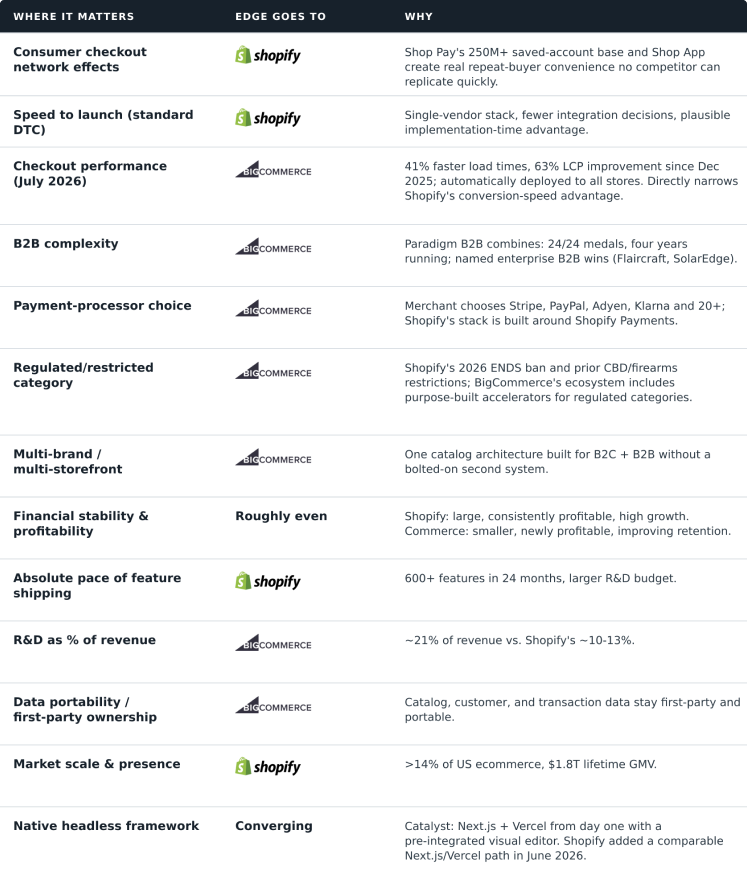
Strengths and Gaps of Shopify and BigCommerce
Should You Stay, or Should You Go?
There is no universal answer, and anyone offering you one, including a slide deck with your name on it, Ms./Mr. Merchant, is selling, not advising. What follows is a decision framework, not a verdict.
Lean toward Shopify if:
You run a single brand with a relatively standard B2C catalog and consumer-social-heavy acquisition, where Shop Pay's saved-account network genuinely reaches your buyers.
Your backend complexity is low: limited or no ERP/PIM integration debt, no multi-entity or multi-currency B2B logic, no regulated-category compliance burden.
You value a single-vendor stack and are comfortable trading some control over the Shop App customer relationship for its convenience and reach.
Your switching cost off your current platform is genuinely low. The newer and less customized your current build, the more a TCO argument can actually hold up under your own numbers.
You want to go all-in on headless custom web application, but stay inside Shopify's own hosting and support relationship: Hydrogen on Oxygen (or now on Vercel) keeps you closer to a single-vendor stack than BigCommerce's Catalyst does.
Lean toward staying on (or moving to) BigCommerce if:
You operate B2B, B2C, or both from one catalog, with price lists, quoting, multi-buyer roles, or ERP/PIM/OMS integrations that a rebuild would need to reproduce from scratch.
You manage multiple brands or storefronts and need one architecture rather than bolting on a second system.
You sell in a category where platform or payment-network policy risk is a live concern, such as cannabis-adjacent, alcohol, firearms and accessories, supplements, or anything that has already seen a card-network-driven restriction.
You need payment-processor flexibility for cost, geographic, or risk-diversification reasons, rather than a single recommended processor.
You already have significant integration and data-pipeline investment sunk into your current architecture. The switching cost itself is very likely the largest true line item in any TCO comparison.
Your team already builds in Next.js and wants a native, deploy-anywhere headless path with a marketer-usable visual editor pre-integrated. This is Catalyst's most mature advantage over Hydrogen today.
Checkout performance and speed matter significantly to your conversion metrics, and you want the latest infrastructure optimizations without waiting for a future Shopify release.
The honest middle case:
A fast-growing mid-market brand that has outgrown a template storefront but isn't ready to fund a fully custom, from-scratch composable build is the segment where this decision is genuinely close, and where a canned TCO number from either vendor is least trustworthy.
This is also the segment BigCommerce Catalyst (and comparable web accelerator-based approaches) was built for: enterprise-grade headless flexibility without the full custom-build price tag. It's worth an actual, merchant-specific model before deciding either way.
AI Strategy: Which One Is More Sound Right Now?
This is the question we at Mira get asked most, and it deserves a real answer rather than a hedge; so here is mine, with the evidence on both sides.
Shopify's position: broadest, most integrated, most used today.
Shopify is running two coordinated AI tracks and reporting real usage numbers for both, which is more transparency than most vendors offer. On the merchant-facing side, Sidekick (its AI store-management copilot) logged 34 million conversations, daily active usage up 3.6x year-over-year, and 36,000 custom apps built through it in a single quarter, up from 12,000 the quarter before. On the consumer-facing side, Shopify Catalog, checkout, and the Universal Commerce Protocol (co-developed with Google) already connect merchants to ChatGPT, Google's AI Mode and Gemini, and Microsoft Copilot, with a new "Agentic" section shipped directly into merchant admin so brands can see, in real time, which AI channels they're live on and where discovery is or isn't converting. This is a coherent, single-vendor stack that a merchant can turn on today, backed by numbers Shopify is willing to publish.
By the way: check out how many agentic-originated transactions have been made on Shopify platform across their entire installed base so far - Shopify claims they "tripled" the Q2 2026 volume off of the base they did not name, so its anyone's guess now.
BigCommerce/Commerce's position: the more protocol-neutral bet, earlier in its proof.
Commerce's architecture is explicitly built not to marry one AI standard while the market is still forming. Feedonomics' Agentic Catalog Exports went live in April 2026, syndicating merchant catalogs (Dell is among the named customers!) to both OpenAI and Google Gemini rather than one camp. Agentic checkout through PayPal has been live since October 2025 and is connected to Perplexity's shopping product; BigCommerce also points to its own MCP support for direct agent-to-store transactions and the B2B MCP is going live very soon. The philosophical position, which is - speak UCP, ACP, AP2, and MCP rather than bet the business on one, is the more architecturally defensible stance if the agentic-commerce market ends up as fragmented as it currently looks (four competing protocols and counting). But it is a bet on a market structure that hasn't resolved yet, and Commerce has not published usage numbers at the scale or specificity Shopify has. There is no public equivalent to "34 million conversations" or "3.6x DAU growth" that I know of as their partner or can locate.
My verdict:
If "sound" means most shipped, most used, and most coherent today, Shopify is ahead, and not narrowly, controlling both the merchant and consumer sides of its own stack lets it move faster and prove it publicly. If "sound" means best-positioned for a market where no single agent protocol has won yet, Commerce's neutrality is the more defensible long-term architecture. But it is currently an argument, not yet a track record at Shopify's scale. A merchant who needs a working answer and a proof of concept this quarter should weight Shopify's execution more heavily. A merchant designing a five-year architecture, especially one that can't afford to have bet on the wrong protocol camp, should weight Commerce's neutrality more heavily. Both are legitimate ways to read the same evidence. As one of my client's CEO recently stated: "Sergei, I don't need scattered AI experiments across my company, I need an enterprise data and AI strategy, which should include an E-commerce AI strategy part in it, and we can't be tied to one vendor or protocol, at least not yet."
Where This Is All Going
If we zoom out from the Shopify-vs-BigCommerce argument and a bigger pattern is already visible across the industry, and it shows up in both companies' own 2026 moves. Infrastructure is consolidating around AI-ready, composable content and data layers. Salesforce's acquisition of Contentful and SAP's multi-year composable-commerce pivot are both about feeding structured content to AI agents rather than human-edited web pages. Discovery and checkout are migrating off any single merchant's own site into third-party agentic interfaces and Shopify's checkout payment moves are two different architectural answers to the same shift. Regulated-category merchants are absorbing outsized, often single-notice risk when commerce infrastructure and the payment rails underneath it are centralized in one vendor's hands, as 2026's ENDS ban and its CBD and firearms precedents show. And strategic identity clarity is becoming a competitive asset in its own right, I think - Commerce's rebrand and repositioning around openness is a bet that a clearly stated identity reads as conviction in a confusing market, the same way Shopify's steadier "we power entrepreneurs" story has for years.
None of this means either platform is obsolete or has already won. It means the actual decision in front of you is bigger than a templated TCO battle slide: it's how exposed you want to be to a single vendor's payment-network risk tolerance, how easily your catalog data can be read by whichever agent your customers use next, and whether your platform partner's strategic story still makes sense to you in three years, not just this quarter.
I love the Amazon warehouse analogy. Those 'dark' fulfillment centers that don't need heat or lights because robots are running the show. Apply that same idea to the future of E-commerce: when AI agents are the ones doing the shopping via agentic protocols like MCPs, what happens to traditional, human-oriented website UIs? And what does a marketer or merchant actually do in that world?
It all comes down to data! Normalizing, enriching, guard-railing, and distributing it. That's the real name of the game. So if you're stuck on a platform that dictates how you can expose or use your own data, you should definitely be concerned.
How Mira Commerce Can Help
We build on BigCommerce, and we're not going to pretend that's not true. But the reason I wrote this article exists is that too many merchants are being asked to make a six- or seven-figure infrastructure decision off a sales deck built to win one meeting and throw a discount that is "only available this quarter!", from either vendor. What we actually offer is a platform-agnostic starting point:
A TCO model built on your real payment mix, app stack, integration footprint, and switching cost. Not a 2024 industry average from either company but YOUR OWN.
A stay-or-go architecture assessment weighted to your actual complexity: B2B logic, multi-brand catalogs, multi-brand / multi-domain storefronts, ERP/PIM/DAM/OMS integrations, regulated-category exposure, and industry vertical specifics.
Sector-built accelerators,including Caliber.app for regulated categories like firearms, tactical, and outdoor, and ForgeB2B.app for complex B2B that shorten the path to a composable build without a from-scratch price tag.
An agentic-commerce readiness audit: is your catalog data structured for how AI agents actually read it, and are you exposed across UCP, ACP, MCP, and whatever comes next, regardless of which commerce platform you're on.
If you're one of the merchants who's already taken that call from Shopify or you're wondering whether you should be asking BigCommerce the same hard questions, we'd be glad to walk through your own numbers and rationale with you. That's a better conversation than either sales deck is set up to have.