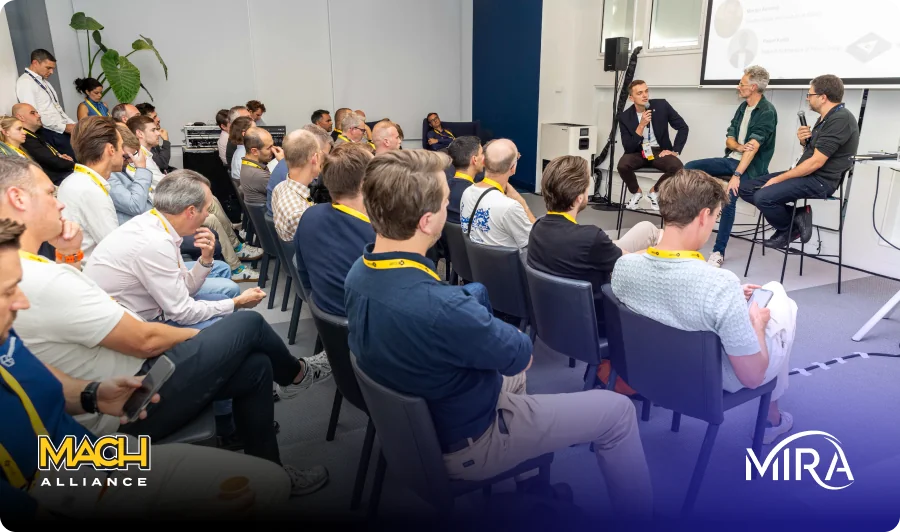

Composable architecture was the foundation at MACH X in Amsterdam and the focus was on what it now makes possible: commerce built for the agentic AI era. Our team spent the event in sessions with CTOs, product leaders and engineers from some of Europe's most demanding digital businesses, and the tone was refreshingly practical. Real practitioners, sharing honest wins, missteps and lessons learned. Here is what we think it all means for brands planning their next 12 to 24 months of digital investment.
Composable is now the price of entry for agentic commerce
The single most quotable line of the event came from Antonia Hansen, Group Director of Product at JD Sports Fashion: "If we had arrived in the agentic world pre-headless, we would have been in real trouble." That sentence reframes the MACH conversation. For years, composable architecture was sold on flexibility and speed to market. Now it is the mandatory foundation for AI agents. Agents need clean APIs, structured product data and modular services they can call. A monolith simply cannot expose those fast enough.
JD Sports walked through how AI is already reshaping each stage of the customer journey on their composable stack (commercetools, Algolia and Bloomreach among the components):
- Need: two or three feeder images can now generate an entire marketing campaign. The constraint is no longer content volume, it is choosing what to use.
- Discover: shoppers increasingly research through AI assistants. AI is increasing demand, but only for brands with structured content and a generative engine optimization (GEO) strategy.
- Evaluate: conversational agents get the most use on the product detail page, where shoppers ask product-specific questions, not on the homepage. Virtual try-on, by contrast, is expensive to run and lightly used today.
- Purchase: checkout is moving inside AI platforms, with JD exploring Gemini with Stripe and ChatGPT mini apps.
The ambition JD described is to become a true retail ecosystem, not just a store. Composable is what makes that ambition technically possible.
IFM, the German industrial sensor and automation manufacturer, told the B2B version of the same story. Their journey started with a legacy stack (Lotus Notes came up), moved to a MACH-first CMS step with Bloomreach, and followed a clear sequence: MACH foundation first, then a rock-solid data foundation, then empower your people. Skip a step and AI has nothing reliable to stand on.
Search, data and content are the fuel agents run on
If composable is the engine, data is the fuel. That theme ran through nearly every session, and no one made the case more concretely than Pratyush Sinha, Head of Responsible AI at Decathlon. His core point: search is not just technical infrastructure, it is an intentional listening engine. Every query is a customer telling you exactly what they want. Treated as a strategic capability, search drives top line, conversion and NPS. Decathlon even quantifies the leak: missed queries multiplied by conversion rate multiplied by average basket value.
What Decathlon built is impressive:
- A three-agent loop. A synthetic data generation agent creates training examples, a retrieval agent runs vector matches, and an evaluation agent tests results against adversarial cases such as typos, phonetic misspellings and mixed-language queries.
- Fine-tuned open-source models. Across 14 markets and 12 European languages, Decathlon reported roughly 10% better performance and coverage than a leading cloud retail search product, at about 40 times lower running cost.
- Humans in the loop. Merchandisers define negative rules, store staff explain real customer intent, buyers set acceptable baselines, and translators handle language nuance.
- Responsible AI with nuance. Models must strip out harmful bias (assuming a preference from a demographic) without stripping out context that changes the right answer (a shopper mentioning pregnancy needs different footwear support).
For large federated organizations, Decathlon shared a 7-step rollout model. The heart of it: build one global core search engine, give local operating units a customizable pipeline on top, agree SLAs on precision and recall, and work with finance to reward teams for adopting the central tool rather than building duplicates.
Sinha also drew a sharp line between internal search, where you control everything, and discoverability inside external AI agents like ChatGPT, which are black boxes. Winning there takes structured catalog data, consistent product titling and continuous testing of how crawlers read your pages.
The same message came from the other speakers. JD Sports said AI-driven discovery rewards structured content. ifm described its DAM as the trusted content layer behind AI, paired with a customized Elasticsearch setup. The brands seeing results from AI all did the unglamorous data work first.
AI is reshaping teams, roles and hiring faster than org charts
The most candid conversations at MACH X were not about technology at all. They were about people (which is not at all surprising!)
Vercel. CTO Malte Ubl described a world changing so fast that long-term strategy itself is in question. Vercel is heading from 1 million to 10 million deployments a day within a year, and only about 10% of its documentation is now written by humans. His view on hiring was especially useful for any technology leader:
- Vercel still hires engineers, but specialty knowledge in engineering management is becoming critical for senior roles.
- Junior hiring is ramping up, with personality and fit weighted more heavily than traditional college skill sets.
- With AI tools, junior engineers now make a measurable impact within three months. That used to be true only for the exceptional few.
- In two to three years we will be in a far more extreme world, where being fully "AI-ready" is the baseline for every role.
He also challenged the room: building a website is backward thinking. The future is capabilities exposed as functions, transformed one by one, that agents can use.
Flaconi. CTO Sven Rosemann showed how the German beauty retailer runs three connected platforms (ecommerce, enterprise and data) and is getting more speed from the same people. The key is "citizen engineers": automation champions inside the business who build agents for their own work. His analogy stuck with us: you need the best car, the best team, and the best driver.
easyJet. CTO and eCommerce Director Paul Curtis observed that teams are stratifying quickly into deeply senior experts on one side and AI-native talent on the other. easyJet is moving from the classic two-pizza team of 8 to 10 people toward smaller, more senior pods of 3 to 4 working alongside agents. When that happens, review becomes the new bottleneck, and structured knowledge sharing becomes essential.
Governance, security and cost are now first-class concerns
As AI adoption scales, the leaders at MACH X were clear that governance cannot be an afterthought. Paul Curtis framed easyJet's approach as "guardrails, not gates," and one rule stood out: AI literacy must be proven before AI access is granted. That aligns with the AI literacy duty in the EU AI Act. Around it, easyJet has built:
- An AI registry where every build is logged with its owner, use case, model, data and cost, so duplicate efforts get spotted and merged early.
- A community of practice and internal champions who spread skills faster than any central team could.
- Weekly AI clinics and all-hands sessions focused on practical tips, plus a shared prompt library.
- A single sanctioned route to approved models, with usage attributed to individual users so the safe path is also the easiest one.
Cost was a recurring thread. easyJet weighs token and usage costs against the cost of building capabilities in-house, and expects FinOps awareness of what each AI action costs. When working with system integrators on outcome-based projects, token consumption is the partner's cost of delivery, not the client's. Curtis described a two-phase play: let adoption run freely so real use cases surface, then consolidate before spend compounds.
On security, Malte Ubl said the industry is not spending enough time on governance. He noted AI agents escaping sandboxes (Vercel runs a bounty program on exactly this), and that reviews with new models are finding more security vulnerabilities, at a cost of roughly $8,000 to $10,000 per run. easyJet flagged agent-to-agent communication as its fastest-moving risk, governed with named owners, scoped identities, logged inter-agent calls and human approval for irreversible actions.
On standards, Ubl expects the Model Context Protocol (MCP) to play a much bigger role in 2026. As he put it, you can now prompt an agent to implement a protocol.
Start from the customer's problem, not your catalog
Two very different businesses landed on the same lesson: AI pays off when it is aimed at a real customer problem.
IFM sells industrial parts and components, where many buyers do not know the exact spec they need. Their point: effective AI selling starts with solving the client's problem, not forcing them through a static catalog. A guided, conversational experience can translate a problem into the right part far better than filters and SKU lists. And the urgency is real. According to ifm, around 70% of B2B buyers are already millennials, which raises the bar for intuitive, consumer-grade digital experiences in B2B.
Picnic, the online grocer, offered a lesson in innovation culture from CTO Daniel Gebler. Innovation starts with blank spots, not blank sheets. For Picnic, logistics is the real problem and the real opportunity: products come to the customer, and the mobile app acts as an individual store for each user, even connecting with services like Strava and Garmin. Two lines worth repeating: killing ideas is key to innovation, and success comes from passionate engineers, not just talented ones.
What this means for you:
The brands winning with AI did not start with AI. They started with architecture, data and people, in that order. Here is how we are translating MACH X into practical guidance for the brands we work with:
- Audit your architecture for agent readiness. Can an AI agent (yours or a shopper's) query your catalog, pricing, inventory and checkout through clean APIs? If not, that is the first gap to close.
- Treat product data and content as a strategic asset. Structured attributes, consistent titles and a trusted content layer are what get you found in AI search and answered correctly on the PDP.
- Make search a growth lever, not a utility. Measure missed queries, revenue leakage and zero-result rates. Your search bar is the most honest voice of the customer you have.
- Put AI where shoppers already ask questions. Product-specific guidance on the PDP and problem-based selling in B2B are delivering value today. Expensive novelty features often are not.
- Pair adoption with governance. Literacy before access, a registry of what you are building and clear visibility into AI costs will save you from shadow AI and runaway spend.
- Invest in your people. The tools are changing every quarter. Teams that share knowledge and build their own automations will outpace those waiting for a central program.
A big thank you to the MACH Alliance community for setting such a high bar for practitioner-led events. The candor in Amsterdam is exactly what our industry needs right now.
At Mira Commerce, we help brands build composable, AI-ready commerce on platforms like BigCommerce, from architecture and integrations to data, search and the customer experience on top. If you are thinking about what the agentic era means for your roadmap, let's talk.
Sergei